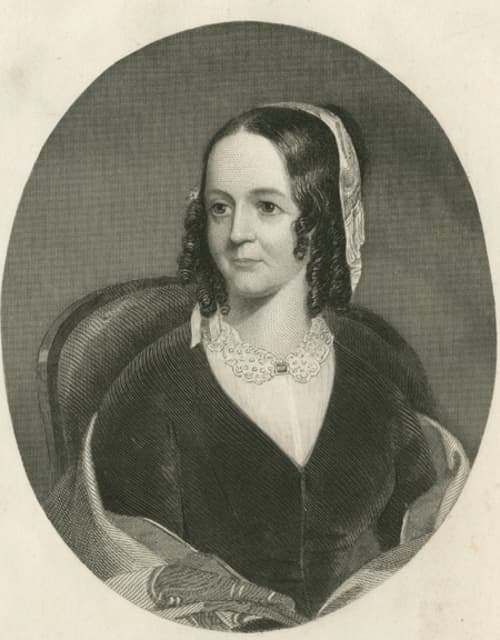
In the middle of the 19th century, a New Hampshire–born editor helped shape what millions of American women read, how they decorated their homes, and even how the nation marked Thanksgiving Day. As editor of Godey's Lady's Book , the most widely circulated women's magazine in the United States before the Civil War, Sarah Josepha Buell Hale used fiction, essays, fashion plates, and advice columns to promote women's education, domestic life, and civic engagement, while also writing the nursery rhyme "Mary Had a Little Lamb" and pressing U.S. presidents to establish Thanksgiving as a national holiday.
Early Life
Born in Newport, New Hampshire, on October 24, 1788, to Captain Gordon Buell and Martha Whittlesay Buell, Sarah grew up in a household that encouraged serious study for both sons and daughters at a time when girls' schooling was limited. Mostly educated at home, she read widely and began writing verse as a young woman, laying the groundwork for a later literary career. In 1813 she married lawyer David Hale; the couple reportedly studied together, treating education as a shared project rather than a male preserve, and they had five children before David's sudden death in 1822 left her a widow with a family to support.
Career
Widowhood pushed Hale to transform a private interest in writing into a profession. She briefly ran a millinery shop but quickly turned to the pen, publishing her first book of poems, The Genius of Oblivion, in 1823 with financial help from her late husband's Masonic lodge. Four years later, she published the novel Northwood: Life North and South, one of the earlier American works of fiction to confront slavery and sectional tensions, which appeared in the United States in 1827 and in London under a different title. The book established her reputation and attracted the attention of Boston clergyman and educator Rev. John Lauris Blake, who invited her to move to Boston in 1827 to edit his new Ladies' Magazine, one of the first substantial American magazines directed at women readers.
As editor of the Boston Ladies' Magazine and, later, the American Ladies' Magazine, Hale did much of the writing herself, producing literary criticism, sketches of American life, poetry, and essays that combined support for women's education with an emphasis on domestic responsibility. Contemporary observer John Neal remarked in 1828, "We hope to see the day when she-editors will be as common as he-editors," a comment often cited as recognizing the significance of her appointment in a male-dominated field. In 1830 she published Poems for Our Children , a collection that included "Mary Had a Little Lamb," which went on to become one of the best-known English-language nursery rhymes and linked her name permanently with children's literature.
In 1837 Philadelphia publisher Louis A. Godey bought the American Ladies' Magazine and merged it into his own Lady's Book , retaining Hale as editor; she relocated permanently to Philadelphia in 1841 to oversee the combined publication. Under her guidance, Godey's Lady's Book grew into the most influential and widely circulated women's magazine in the United States before the Civil War, with a reputed circulation of about 150,000 by 1860—a substantial reach in a country of roughly 31 million people. Through its pages she championed women writers, publishing figures such as Harriet Beecher Stowe and Lydia Maria Child, and used regular columns—including one titled "Employment for Women"—to discuss women's wage-earning work, teacher training, and education at a time when such topics were contested.
Hale's editorial work intersected with hands-on civic organizing. In Boston she founded the Seaman's Aid Society in 1833 to provide income and training for sailors' wives and an industrial school and day nursery for their children, combining charity with employment rather than simple relief. She later supported the Ladies' Medical Missionary Society and advocated for women physicians, arguing that women should be trained as doctors to care for female patients both at home and in foreign missions. Her interest in national identity led her to promote preservation projects for sites such as George Washington's Mount Vernon and Boston's Bunker Hill Monument, for which she helped organize a large fundraising fair at Faneuil Hall in 1840.
Alongside her editorial duties, Hale pursued ambitious book projects. Her most substantial work, Woman's Record; or, Sketches of Distinguished Women , first published in 1853 and later expanded, compiled biographical entries on hundreds of women across centuries and cultures, functioning as both reference work and argument for women's historical importance. She also produced cookbooks, conduct books, and collections of essays that reinforced a vision of domestic life in which women's moral influence, education, and organizational skills shaped families and communities. Although she never aligned herself with formal women's rights movements and often cautioned readers against direct political agitation, she consistently argued for expanded schooling for girls, support for women teachers, and, eventually, the acceptability of women entering certain professions.
Hale's most visible national campaign centered on Thanksgiving. Beginning in the 1840s, she used editorials and letters to governors and presidents to argue for a uniform, nationwide Thanksgiving observance that would promote unity and gratitude across sectional lines. In 1863, amid the Civil War, President Abraham Lincoln issued a proclamation establishing a national Thanksgiving Day in November, and later commentators and historians have widely credited Hale's persistent lobbying and public advocacy as an important factor in that decision.
Legacy
By the time she retired from Godey's Lady's Book in December 1877 at the age of eighty-nine, Hale had edited women's magazines for roughly half a century, influencing several generations of readers. She died in Philadelphia on April 30, 1879, leaving behind a body of work that linked children's verse, popular fiction, historical biography, and prescriptive domestic writing with concrete activism on behalf of women's education, charitable institutions, and historic preservation. Modern assessments of 19th‑century print culture and women's history often single her out as a central figure in the development of the women's magazine as a cultural forum, as well as a key advocate for Thanksgiving, for women's schooling, and for the idea that editing and authorship could be viable professions for American women.